Quick Answer: Can You Get Around Gangneung Without a Car?
Yes. Most first-time visitors can travel around Gangneung without renting a car.
Gangneung does not have a subway system, and its attractions are spread across several different areas. For most visitors, the easiest approach is to use a combination of city buses, taxis, and walking.
If you are traveling on a budget, buses can take you to many of Gangneung’s main attractions. If you have limited time or are traveling with two to four people, using a taxi for selected trips can save a lot of time.
You probably do not need a rental car if your itinerary mainly includes places such as Gyeongpo, Chodang, Anmok, and Jungang Market. A rental car or tourist taxi becomes more useful if you plan to visit several specific outlying attractions in one day, or if you are traveling with children or a lot of luggage.
| Your Trip | Best Option |
|---|---|
| First visit to Gangneung | Bus + Taxi + Walking |
| Budget trip | City Bus + T-money |
| Short trip with limited time | Taxi + Walking |
| Traveling with children or large luggage | Taxi or Rental Car |
| Visiting several outlying attractions | Rental Car or Tourist Taxi |
Still planning how to get to Gangneung? See our guides from Seoul, Incheon Airport, and Busan.
Understand Gangneung’s Layout
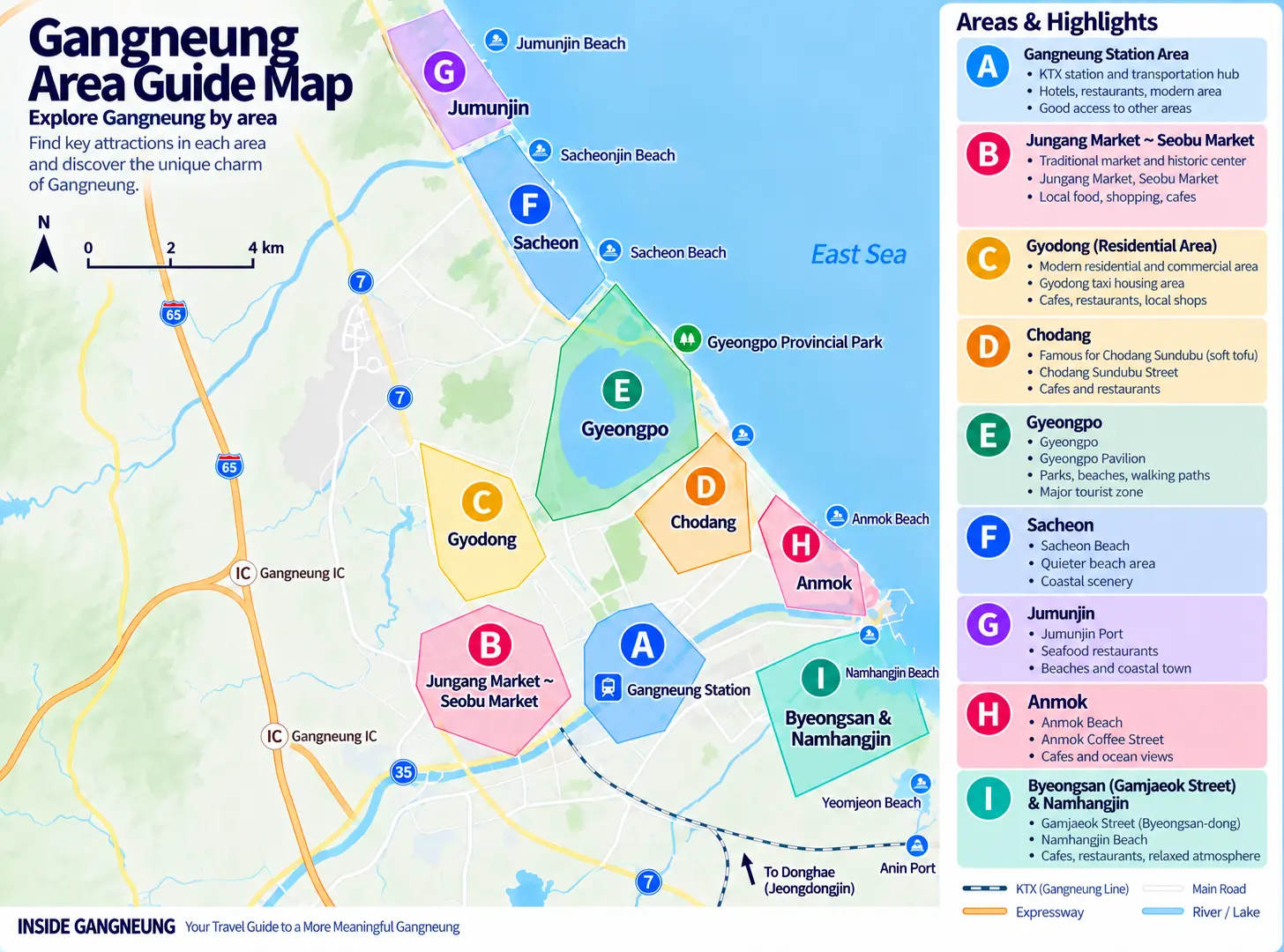
Before choosing how to get around, it helps to understand how Gangneung is laid out.
Unlike cities where most attractions are concentrated downtown, Gangneung’s main sights are spread across several separate areas. Gangneung Station and the traditional market area are inland, while Chodang and Gyeongpo are closer to the coast. Anmok and Namhangjin are farther south, while Sacheon and Jumunjin extend north along the coastline.
For this guide, we divide Gangneung into nine easy-to-understand travel areas.
A — Gangneung Station Area
Gangneung Station and the surrounding area.
B — Market Area
Jungang Market, Seobu Market, Gangneung Daedohobu Government Office, and the traditional downtown area.
C — Gyodong
A busy local district with many restaurants, cafés, and everyday amenities.
D — Chodang
Best known for Chodang Sundubu Village and nearby restaurants and cafés.
E — Gyeongpo
The main Gyeongpo tourism area, including Gyeongpo Lake, Gyeongpodae Pavilion, and Gyeongpo Beach.
F — Sacheon
A quieter coastal area between Gyeongpo and Jumunjin.
G — Jumunjin
The northern tourism area around Jumunjin Port, markets, and beaches.
H — Anmok
Home to Anmok Beach and Gangneung Coffee Street.
I — Byeongsan & Namhangjin
The area around Gamjajeok Street in Byeongsan-dong and Namhangjin Beach.
Walking works well once you are already inside some of these areas. Anmok Beach and Coffee Street, the Jungang Market area, and parts of Gyeongpo are all easy to explore on foot.
For trips between different areas, however, a bus or taxi is usually more practical.
Getting Around Gangneung by City Bus
Gangneung city buses connect Gangneung Station, downtown, Gyeongpo, Chodang, Anmok, Jumunjin, and many other places visitors are likely to go.
You do not need to learn the entire bus network.
Some routes run frequently, while others operate only a limited number of times each day. The easiest strategy is to understand a few useful routes and then check your actual departure time with NAVER Map or Gangneung BIS.
For travelers, these six routes are particularly useful.
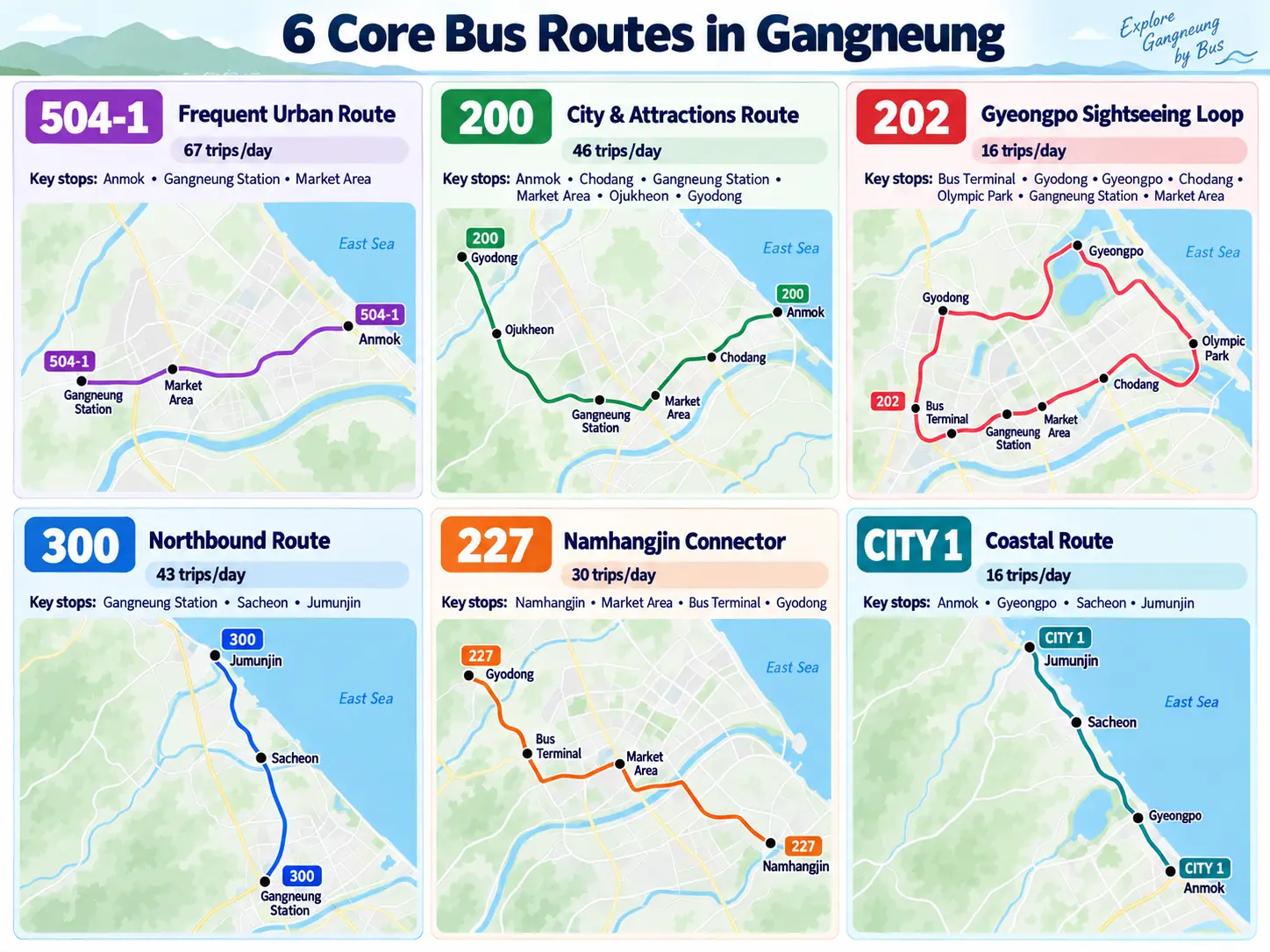
504-1 — Frequent Urban Route
Anmok → E-Mart → Gangneung Station area → Market area
Route 504-1 runs about 67 times per day, making it one of the most frequent routes in this guide.
It is especially useful when traveling between Anmok and central Gangneung.
200 — City & Attractions Route
Anmok → Chodang → Gangneung Station area → Market area → Ojukheon → Gyodong
Route 200 runs about 45 times per day.
It connects several areas that are useful to travelers, including Anmok, Chodang, downtown Gangneung, Ojukheon, and Gyodong.
If you are boarding near Gangneung Station, check the exact stop location in NAVER Map or Gangneung BIS, as this route serves the station area rather than necessarily stopping directly in front of the station entrance.
202 — Gyeongpo Sightseeing Loop
Route 202 is useful for traveling between the Gyeongpo area and several parts of central Gangneung.
It connects areas including:
Gyeongpo → Gyodong → Chodang → Olympic Park → Gangneung Station → downtown
It runs about 16 times per day and follows a large loop around several major visitor areas.
This can be a useful route if you are staying around Gyeongpo and want to reach Chodang, Gangneung Station, or central Gangneung by bus.
300 — Northbound Route
Gangneung Station → Sacheon area → Yeongjin → Jumunjin
Route 300 runs about 43 times per day and is one of the most useful buses for heading north from Gangneung Station.
A taxi from Gangneung Station to Jumunjin can be relatively expensive, so this route is worth checking if you are not in a hurry.
227 — Namhangjin Connector
Namhangjin / Byeongsan → Market area → Bus Terminal → Gyodong
Route 227 runs about 30 times per day.
It is useful for travelers visiting Namhangjin or the Gamjajeok Street area and then heading toward downtown, the bus terminal, or Gyodong.
CITY 1 — Coastal Route
Anmok → Gyeongpo → Sacheon → Jumunjin
CITY 1 is one of the easiest routes for visitors to understand because it follows Gangneung’s coast and connects several major seaside areas.
On the area map, it roughly follows:
H Anmok → E Gyeongpo → F Sacheon → G Jumunjin
If your itinerary includes several coastal areas, this route can be very convenient.
However, it runs only about 16 times per day, so check the timetable before planning your day around it.
Bus Fare and T-money
All six routes above use the regular Gangneung city bus fare.
For adults:
| Payment Method | Fare |
|---|---|
| Cash | ₩1,700 |
| Transport card | ₩1,530 |
T-money works on Gangneung city buses.
If you already have a T-money card from Seoul or another Korean city, you can continue using the same card in Gangneung.
When using a transport card, you can make up to two free transfers within one hour after getting off the bus, subject to the transfer rules.
Remember to tap your card again when you get off the bus if you plan to transfer.
Free transfers do not apply when paying cash, and taking the same route number again does not count as a free transfer.
How to Check Your Bus
You do not need to save every Gangneung bus timetable before your trip.
Two services are especially useful.
NAVER Map
Use NAVER Map for route planning.
Enter your starting point and destination to compare bus and walking options and see which route makes the most sense for your trip.
Gangneung BIS
Gangneung BIS is the city’s official Bus Information System.
Use it to check bus routes, stops, arrival information, and real-time bus information.
NAVER Map → Which bus should I take?
Gangneung BIS → When is my bus coming?
Getting Around Gangneung by Taxi
Taxis are a practical part of traveling around Gangneung.
They are especially useful when traveling directly from Gangneung Station to Gyeongpo or Anmok, when carrying luggage, or when moving between tourist areas without wanting to wait for a bus.
For two to four travelers, splitting the fare can also make short taxi trips quite reasonable.
The current basic taxi fare in Gangneung is:
₩4,600 for the first 2 km
Late-night surcharges apply:
23:00–00:00: +20%
00:00–02:00: +30%
02:00–04:00: +20%
Actual fares may vary depending on distance, traffic, waiting time, and route.
Typical Taxi Fares
| Route | Approx. Fare | Approx. Time |
|---|---|---|
| Gangneung Station → Gyeongpo | ₩8,000–10,000 | ~10 min |
| Gangneung Station → Anmok | ₩9,000–11,000 | ~10 min |
| Gangneung Station → Jungang Market | ₩5,000–6,000 | ~5 min |
| Gangneung Station → Gyodong | ₩6,000–7,000 | ~8 min |
| Gangneung Station → Jumunjin | ₩25,000–30,000 | ~20 min |
| Gangneung Station → Namhangjin | ₩8,000–10,000 | ~10 min |
| Gyeongpo → Anmok | ₩9,000–10,000 | ~10 min |
For example, Gangneung Station to Jungang Market takes about five minutes by taxi but around 20 minutes on foot.
If the weather is good and you have no luggage, walking can be perfectly reasonable. With large suitcases, however, a short taxi ride may be worth it.
For a longer trip such as Gangneung Station to Jumunjin, the difference becomes much larger. Budget travelers may want to check Route 300 before taking a taxi.
Calling a Taxi: k.ride or Kakao T?
Kakao T is one of Korea’s best-known taxi-hailing apps.
For international travelers, however, k.ride is usually the easier option to try first.
k.ride is operated by Kakao Mobility, the same company behind Kakao T, but it is designed specifically with international travelers in mind.
It supports features such as multilingual use, overseas-issued payment cards, easier sign-up options for international visitors, and estimated fares before you request a ride.
k.ride Official
Kakao T Official
International traveler → Try k.ride first
Already familiar with Kakao services → Kakao T is also a good option
Taxi availability can vary depending on your location and time of day.
Local Tip
When visiting quieter or more remote areas, getting a taxi to your destination may be easier than finding one for the return trip.
Before heading to an outlying attraction, check bus times or another way to return to central Gangneung.
It is also a good idea to check the return options for each attraction before you visit.
Should You Rent a Car in Gangneung?
For most first-time visitors, a rental car is not essential.
If your trip mainly includes Gangneung Station, Jungang Market, Gyeongpo, Chodang, and Anmok, you can usually get around comfortably with buses and taxis.
A rental car may actually add extra time for pickup, return, parking, and navigation if your itinerary is relatively simple.
A car becomes more useful if:
- You plan to visit several outlying attractions in one day.
- You are traveling with young children.
- You are traveling as a group of three or four people or more.
- You have a lot of luggage.
- You plan to continue from Gangneung to other destinations along the east coast.
Typical daily rental prices can vary widely, but the following ranges can help with budgeting.
| Vehicle Type | Rough Daily Budget |
|---|---|
| Small / Compact | ₩40,000–70,000 |
| Sedan | ₩55,000–80,000 |
| SUV | ₩70,000–100,000 |
| Minivan / Large SUV | ₩100,000–150,000+ |
Prices vary by date, vehicle availability, insurance, and vehicle class.
International travelers will generally need documents such as a valid International Driving Permit, passport, and original home-country driver’s license.
Age and driving-experience requirements can vary by rental company and vehicle type, so always check the rental company’s conditions before booking.
Foreigner Tourist Taxi
Gangneung also offers a Foreigner Tourist Taxi service.
Unlike a normal taxi ride, this service is designed for travelers who want to visit several attractions over a few hours without arranging transportation between every stop.
Current fare:
3 hours — ₩33,000
Additional time — ₩20,000 per hour
This fare took effect on May 1, 2026.
Online credit-card payments may include a processing fee.
Admission fees, parking fees, tolls, and unusually long-distance charges may be additional.
Online booking is available.
On-site booking at the Gangneung Station Tourist Information Center is also available.
It can be a good option if you want to visit several attractions in a half day without constantly checking bus connections or worrying about finding a taxi back from a quieter area.
For small groups, it can also be worth comparing the total cost with taking several individual taxi rides.
Best Apps for Getting Around Gangneung
You do not need to install every Korean transport app before visiting Gangneung.
These four services cover most situations.
| Service | Best For | Traveler Note |
|---|---|---|
| NAVER Map | Overall navigation, buses, walking | Main route-planning app |
| Gangneung BIS | Real-time city bus information | Official Gangneung bus service |
| k.ride | Taxi calling | Best first option for international travelers |
| Kakao T | Taxi calling | Useful if you already use Kakao services |
For many international visitors, NAVER Map + k.ride will cover most everyday transportation needs.
If you plan to use city buses frequently, add Gangneung BIS for real-time bus information.
Late-Night Travel & Luggage Tips
Late at Night
Gangneung bus service becomes more limited in the evening.
Some useful tourist routes also finish earlier than the busiest city routes, so do not assume that the same bus you used during the day will still be available late at night.
Before spending the evening at Gyeongpo, Anmok, Jumunjin, or another area away from your accommodation, check your return route in advance.
Use NAVER Map or Gangneung BIS to check the last bus.
If buses have finished for the night, k.ride, Kakao T, or a regular taxi will usually be the most practical alternative.
Remember that late-night taxi surcharges may apply.
Traveling with Luggage
If you arrive in Gangneung with large suitcases, taking a taxi for your first trip may be much easier than using a bus.
For example, Gangneung Station to Gyeongpo or Anmok takes only around 10 minutes by taxi.
Luggage storage is also available around Gangneung Station if you want to explore before checking into your accommodation.
Opening hours, prices, and available services can change, so check the latest information on the day you plan to use them.
FAQ
Can I use T-money in Gangneung?
Yes.
T-money works on Gangneung city buses.
Using a transport card also gives you a lower fare than paying cash and allows free transfers when the transfer conditions are met.
Remember to tap your card when getting off if you plan to transfer.
How late do buses run in Gangneung?
It depends on the route.
Some major buses operate until around 9 p.m. or later, while tourist-oriented or less frequent routes may finish earlier.
For late-evening travel, check the last departure on NAVER Map or Gangneung BIS rather than relying on a fixed timetable.
Do I need a rental car in Gangneung?
For most first-time visitors, no.
If you are mainly visiting Gyeongpo, Chodang, Anmok, Jungang Market, and central Gangneung, buses and taxis are usually enough.
A rental car becomes more useful if you plan to visit several outlying attractions, travel with young children or a lot of luggage, or continue your trip to other destinations along Korea’s east coast.
3 thoughts on “Getting Around Gangneung: Buses, Taxis, Rental Cars & Apps”